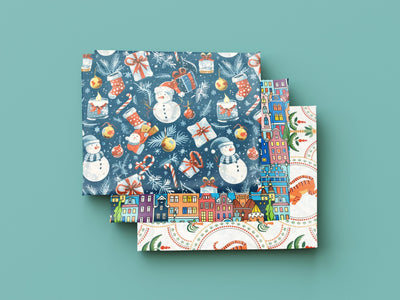
A fat quarter is a quarter of a metre cut fat rather than long: in the UK, usually about 50cm x 55cm from a 110cm bolt, or 50cm x 70cm from a 140cm one. Same area as a long quarter, squarer shape. Sizes vary with bolt width, so check the listing before you cut.
That is the answer. The rest of this piece is about why the shape matters more than the area, because that is the part that decides whether the thing you want to make will actually come out of the piece you bought. Everything below is worked with a 50cm x 55cm fat quarter, the commonest UK size, and it is the size of the fat quarters in our fat quarter bundles. The wider quilting fabrics range is sold by the metre if you want to cut your own.
Fat quarter vs long quarter vs metre
Fabric comes off a roll at a fixed width. Ask for a quarter of a metre and you get a strip 25cm deep and the full width of the bolt – a long quarter, sometimes called a skinny quarter. Ask for a fat quarter and the shop cuts half a metre, then cuts that in half down the middle. The area is identical. The shape is not.
| Cut | Bolt width | Approx size | Area | Longest single piece |
|---|---|---|---|---|
| Fat quarter | 110cm | 50cm x 55cm | 0.275 m² | 55cm |
| Fat quarter | 140cm | 50cm x 70cm | 0.35 m² | 70cm |
| Fat quarter (18in x 22in) | Imported/US | 46cm x 56cm | 0.257 m² | 56cm |
| Long (skinny) quarter | 110cm | 25cm x 110cm | 0.275 m² | 110cm |
| Half metre | 110cm | 50cm x 110cm | 0.55 m² | 110cm |
| One metre | 110cm | 100cm x 110cm | 1.10 m² | 110cm |
| One metre | 140cm | 100cm x 140cm | 1.40 m² | 140cm |
Read the last column. A long quarter will give you a 110cm strip and a fat quarter will not give you anything over 55cm – but the long quarter is only 25cm deep, so it will not give you a 40cm cushion front, a bag panel or a bib. Same fabric, same money, and each one can do a job the other cannot.
So the useful rule is: long quarters are for length, fat quarters are for pieces. Binding, sashing, borders, straps, waistbands and ties want a long quarter, because one 25cm x 110cm strip cut into four 6cm strips gives you 4.4m of binding. Anything with a shape – a pouch, a panel, a pocket, a patchwork block – wants a fat quarter.
Cutting your own fat quarters from a metre
If you want a lot of one print in fat-quarter form, buying a metre and cutting it yourself is cheaper than buying four fat quarters. One metre of 110cm cotton gives four fat quarters at 50cm x 55cm, with nothing wasted. At £1/m that is 25p a fat quarter; at £3/m, 75p.
Do it properly or the pieces will be off-grain and every seam you sew from them will pull. Square the end first: snip into the selvedge and tear across, or pull a single crosswise thread and cut along the gap it leaves. Cotton tears cleanly on the grain and the torn edge is more accurate than most rotary cuts. Then measure 50cm down from the squared end, cut across, fold that half-metre selvedge to selvedge and cut down the fold. Four fat quarters, four minutes.
Two things to know before you cut. Quilting cotton often shrinks a little on its first wash, so if the finished item will be washed, prewash the metre before you cut it into quarters (how to wash fabric properly covers temperatures). Even a centimetre or two lost on a 50cm piece is enough to spoil a matched set. And a fat quarter has two raw edges where the long quarter has one, so it frays faster in a basket; if you are storing a bundle unused for months, overlock or pink the cut edges.
Check before you buy. Fat quarter dimensions are not standardised. A 50cm x 55cm UK cut, a 50cm x 70cm cut from wide cotton and an imported 18in x 22in cut are three different pieces of fabric, and the smallest is about 27% less fabric than the largest. If a pattern says "one fat quarter", check what size it assumed. If a listing does not state the dimensions, ask.
Why quilters prefer fat quarters
Quilting is mostly cutting squares, strips and triangles out of a small number of coordinated prints. A 25cm-deep long quarter caps every piece you cut at 25cm, which rules out a 30cm block, a 26cm half-square-triangle unit and most border cornerstones. A fat quarter at 50cm x 55cm cuts:
- Twenty 11cm squares (a 4 x 5 grid), with a strip left over
- Nine 6.5in (16.5cm) squares – the standard block-building size
- Four 8in (20cm) squares plus a 15cm strip left over
- One 12.5in (31.7cm) finished block, and nothing like a second – that size eats a whole fat quarter
- Nine 14cm half-square-triangle starting squares, giving eighteen units
The second reason is variety per pound. A quilt looks better with fourteen prints than with four, and buying fourteen half metres means 7m of fabric you do not need. Fourteen fat quarters is 3.85 m² against 7.7 m² – half the fabric, all of the variety. That is the whole appeal, and it is a real one.
Twenty things that fit in one fat quarter
Cut sizes below include a 1cm seam allowance unless stated, and assume a 50cm x 55cm fat quarter. Costs are worked examples at indicative rates – single fat quarters commonly sell for around £1.50 to £2.50, so the sums use £2 and you can rescale.
Straightforward – an hour or less
| Make | Cut list | Fat quarters | Fabric cost at £2/FQ |
|---|---|---|---|
| 1. Lavender bags x3 | 6 squares 13cm x 13cm | 1 (about a third of it) | ~75p of the FQ |
| 2. Scrunchies x2 | 2 strips 55cm x 11cm | 1 (under half) | ~90p of the FQ |
| 3. Key fobs x6 | 6 strips 28cm x 5cm | 1 (about a third) | ~60p of the FQ |
| 4. Bunting, 1.5m | 20 triangles 14cm x 16cm (10 lined flags) | 1 | £2.00 |
| 5. Drawstring bag, 20cm x 26cm | 2 pieces 22cm x 30cm | 1 | £2.00 |
| 6. Reusable face pads x8 | 16 circles 9cm diameter | 1 (half of it) | ~£1 of the FQ |
| 7. Napkin, 42cm finished | 1 square 46cm x 46cm | 1 | £2.00 |
| 8. Dog bandana, tie-on | 2 triangles from a 48cm square | 1 | £2.00 |
| 9. Tissue holders x3 | 3 pieces 20cm x 14cm | 1 (a third) | ~65p of the FQ |
| 10. Mug rug | 1 top 25cm x 18cm, 1 backing same, scrap wadding | 1 | £2.00 |
A bit more to it – one or two sittings
| Make | Cut list | Fat quarters | Fabric cost at £2/FQ |
|---|---|---|---|
| 11. Zip pouch, 20cm | 4 pieces 23cm x 16cm (2 outer, 2 lining) | 1 for both if same print, else 2 | £2.00-£4.00 |
| 12. Coaster set of 4 | 8 squares 12cm x 12cm + scrap wadding | 1 | £2.00 |
| 13. Pot holders, pair | 4 squares 20cm x 20cm + insulated wadding | 1 | £2.00 |
| 14. Baby bibs x2 | 4 pieces 22cm x 26cm | 1 | £2.00 |
| 15. Book sleeve, paperback | 2 pieces 24cm x 40cm | 1 | £2.00 |
| 16. Cushion cover, 40cm envelope | Front 42cm x 42cm; backs 2 pieces 42cm x 26cm | 2 | £4.00 |
| 17. Doll's or pram quilt, about 36cm x 45cm | 20 squares 11cm x 11cm for the top | 1 for the top, 1 for the backing | £4.00 |
| 18. Pincushion and needle book | 2 squares 13cm, 2 pieces 22cm x 14cm | 1 (about a third) | ~70p of the FQ |
Worth the practice
| Make | Cut list | Fat quarters | Fabric cost at £2/FQ |
|---|---|---|---|
| 19. Fabric basket, 15cm cube | 4 outer panels 17cm x 17cm, base 17cm x 17cm, same again in lining | 2 (outer + lining) | £4.00 |
| 20. Reversible bucket hat, child | Crown 6 panels 14cm x 12cm, brim 2 arcs, side band 2 pieces 55cm x 9cm – at the limit of one FQ | 1 per side, so 2 | £4.00 |
Put two of the small makes together and one £2 fat quarter gives three lavender bags and six key fobs with a strip to spare: nine finished items for under £1.40 of fabric. That is the arithmetic behind small handmade gifts (and why starting Christmas sewing early pays), and it is also the arithmetic behind a craft stall; there is a full costing in the guide to sewing projects to sell at craft fairs UK.
What does not fit, and why
The hard limit is 55cm. Nothing longer than that comes out of a standard UK fat quarter in one piece, and that rules out more than people expect:
- Any adult garment piece. A bodice front needs 60cm-plus, a sleeve 55cm-plus on the grain once you add hem. A skirt panel is nowhere near.
- A 45cm cushion cover from one piece. The front alone is 47cm square. You need two fat quarters, or one half metre.
- A lined tote. Outer, lining and straps come to about 1.4m of 110cm fabric – five fat quarters' worth of area, and the 60cm straps will not cut from one at all.
- Long binding. A fat quarter gives 55cm strips, so a quilt binding means joining a dozen short lengths. A long quarter gives 110cm strips and half the joins.
- Directional prints at full scale. With only 50cm along the grain, a print with an obvious up and down limits your layout badly. Check the print direction before you buy for anything with a strong motif.
For anything on that list, buy by the metre. The companion piece on what you can make with 1 metre of fabric covers where the line sits, and the general quantities are in how much fabric you need.
Bundles vs singles: the cost per square metre, honestly
Fat quarters cost more per square metre than fabric off the roll. That is not a criticism – somebody cut, folded and packed them, and you are buying variety – but it is worth seeing the number rather than guessing at it.
| How you buy it | Worked example | Area | Cost per m² |
|---|---|---|---|
| Single fat quarter | £2.00 each | 0.275 m² | £7.27 |
| 4-piece fat quarter bundle | £7.50 the bundle | 1.10 m² | £6.82 |
| By the metre, 110cm wide | £3.00/m | 1.10 m² | £2.73 |
| By the metre, 110cm wide | £1.00/m | 1.10 m² | 91p |
| By the metre, 140cm wide | £3.00/m | 1.40 m² | £2.14 |
Those are illustrative figures, so check current prices, but the pattern holds: a bundle is cheaper than the same number of singles, and both cost more per square metre than the roll. So the decision is simple. Need volume of one fabric – a backing, a lining, a tote, curtains? Buy metres. Need fourteen different prints that go together? Buy a bundle, and accept the premium for the coordination and the cutting. The longer argument for bundles is in why fabric bundles make sense.
The mixed order. The cheapest way to make a quilt is usually both: a fat quarter bundle for the top, and a metre or two off the roll for the backing and binding. A 100cm x 150cm lap quilt takes about ten fat quarters plus 1.7m of backing – roughly £20 of fat quarters at £2 each and £5.10 at £3/m, so about £25 of cotton before wadding.
Building a coordinated bundle
If you are choosing your own selection rather than buying a ready-made one, four rules will save you from the flat, muddy result that puts beginners off patchwork.
Vary the scale. This is the one people miss. A pile of prints that are all medium-sized florals reads as visual noise from two metres away. Aim for one large-scale focal print, three or four mediums, three or four small prints or blenders, and two near-solids. The near-solids are what let the eye rest.
Keep one colour common. Pick a colour that appears somewhere in every print, even as a small detail. That single thread is what makes ten unrelated fabrics look chosen rather than collected.
Check the values, not the colours. Photograph your stack and look at it in black and white on your phone. If everything turns the same mid-grey, the quilt will have no pattern in it no matter how pretty the prints are. You want obvious lights, mediums and darks.
Buy the focal print by the metre. If one fabric is doing the heavy lifting, a fat quarter of it will run out. Get half a metre or a metre of the focal and fat quarters of the rest. Most shops let you mix – build your own bundle exists precisely for that.
One last practical note for beginners. Fat quarter bundles are usually quilting-weight cotton, which is the easiest fabric there is to sew: it holds a crease, it does not shift under the foot and it forgives a wobbly seam. If you have been struggling with fabric that slides or puckers, that is the fabric, not you – the piece on fabric types beginners should avoid explains which ones to leave alone for now. And if you want a quick project to use the first one on, the easy Halloween sewing projects list has several small makes that suit one.
Measure your fat quarter when it arrives, write the size on a sticky note and keep it by the cutting mat. Every layout decision you make for the next year starts with that number.
Frequently asked questions
What size is a fat quarter in the UK?
Usually about 50cm x 55cm, cut from 110cm-wide quilting cotton. From a 140cm bolt you may get 50cm x 70cm, and imported fat quarters cut to 18in x 22in are roughly 46cm x 56cm. The size depends on the bolt width, so always check the listing.
What is the difference between a fat quarter and a long quarter?
They are the same area, cut differently. A long quarter is a full-width strip 25cm deep, so about 25cm x 110cm. A fat quarter is half a half-metre, about 50cm x 55cm. The long quarter gives you length for binding and borders; the fat quarter gives you width for pieces and panels.
What can you make with one fat quarter?
A 20cm zip pouch, three lavender bags, four coasters, two scrunchies, a drawstring bag, a 42cm napkin, eight reusable face pads, a small fabric basket or twenty 11cm patchwork squares. Anything needing a piece longer than 50cm on the grain will not fit.
Are fat quarter bundles good value?
For variety, yes. Per square metre they cost more than buying by the metre – a fat quarter is only about 0.275 square metres – but a bundle is cheaper than the same number of single fat quarters and solves the colour-matching problem. Buy by the metre when you need volume of one print.