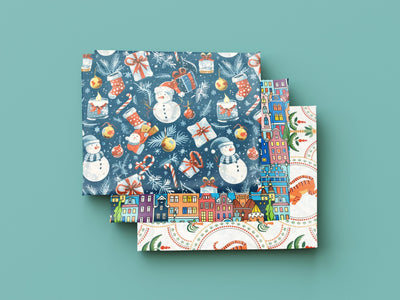
To make fabric bunting, you cut pairs of fabric triangles, sew each pair together along the two long sides, turn them right side out, and stitch the open tops into a long folded strip of tape. With standard flags cut 20cm wide and 22cm tall, one metre of 112cm wide cotton makes 20 double-sided flags, enough for about 5 metres of bunting. It is one of the easiest things to sew: straight seams, no fitting and no fastenings. This guide covers flag sizes, how much fabric and tape you need, the steps in order, a quicker single-layer version and ideas for Christmas, parties and the garden.
Bunting suits almost any light, woven cotton. With Christmas a few weeks away, our Christmas fabrics are an obvious place to start, and a string of festive bunting can be cut and sewn in an evening.
What you need
- Fabric for the flags: the amount from the table below. Printed cotton, polycotton and fat quarters all work well.
- Tape to hold the flags: bias binding, wide ribbon, or tape you make yourself from a strip of plain fabric (see step 6).
- A template: a triangle of card or cereal box, cut to the flag size you want.
- Basics: thread, pins or clips, fabric scissors, a ruler, a pencil or chalk, and an iron. A rotary cutter and mat make cutting lots of triangles much faster, though scissors are fine.
A sewing machine is quickest, but bunting can be sewn by hand with a small running stitch. If your fabric is likely to shrink, wash and press it before cutting so the flags stay the same size the first time the bunting is washed; how to wash fabric properly explains what to do for each fibre.
Bunting flag sizes and how much fabric you need
There is no single official bunting size, but three sizes cover most projects. The cutting sizes below include a 1cm seam allowance on the two long sides. Each double-sided flag needs two triangles, and the triangles are cut alternately point up and point down along a strip, so they nest together with very little waste.
| Flag size | Cut each triangle (base x height) | Flags in 3m of bunting | Fabric, 112cm (45in) wide | Fabric, 140cm (55in) wide |
|---|---|---|---|---|
| Mini (tree, shelf, cake table) | 14cm x 16cm | 20 | 0.5m | 0.5m |
| Standard (indoor, parties) | 20cm x 22cm | 12 | 0.7m | 0.5m |
| Large (garden, fetes, halls) | 26cm x 30cm | 9 | 0.9m | 0.6m |
The flag counts assume a small gap between flags: about 3cm for mini, 5cm to 7cm for standard and about 8cm for large. You also need tape for the whole length plus a tie at each end, so 3m of flags with 25cm ties takes about 3.5m of tape. For single-layer flags with pinked edges, halve the fabric.
For a longer string, work it out from the strip. A 22cm strip cut across 112cm wide fabric gives 10 standard triangles; across 140cm wide it gives 13. One metre of 112cm fabric holds four strips, so 40 triangles or 20 flags. The complete UK fabric quantity guide has charts for other projects if you are buying fabric for several makes at once.
Bunting from fat quarters
Fat quarters are ideal for bunting because you get several prints that already go together. A UK fat quarter measures about 50cm x 55cm and gives 18 to 20 mini triangles, or about 8 standard triangles. A 6-piece Christmas fat quarter bundle makes about 24 standard flags, enough for 6m of bunting, with each flag a different print on the front and back if you like. What is a fat quarter? explains UK sizes and how to get the most from each piece.
Choosing the fabric
| Fabric | Good for | Notes |
|---|---|---|
| Printed cotton | Indoor bunting, Christmas, nurseries | Crisp, presses well and takes a sharp point; the classic choice |
| Polycotton | Parties, school fairs, long strings | Cheap, light and creases less than cotton |
| Hessian | Weddings, rustic and harvest themes | Single layer only; fringe the edges or pink them |
| Polyester | Garden and outdoor bunting | Dries quickly and keeps its colour in the sun |
| Tartan | Winter, Burns Night, Christmas | Cut the triangles on the straight grain so the checks sit level |
For most indoor bunting, a light quilting-weight cotton is best, because the points turn out neatly and the flags hang flat. Polycotton costs less and holds its shape well over a long string; cotton vs polycotton compares the two in more detail. Choose prints with a small, all-over design. A large motif can end up cut in half on a small flag.
Bunting that stays outside all summer needs a fabric that copes with rain. Polyester and polycotton dry much faster than pure cotton and are less likely to mildew; is polyester waterproof? explains how far you can rely on it. Bring any fabric bunting in during long spells of wet weather.
How to make bunting: step by step
1. Make a template
On card, draw a line the width of the flag base, for example 20cm for standard flags. Mark the centre, measure straight down 22cm and mark the point. Join the point to each end of the base and cut out the triangle. A template keeps every flag the same, which matters more than the exact size you choose.
2. Cut the triangles
Fold or lay the fabric flat and cut a strip the height of the template, 22cm for standard flags, across the full width. Place the template at one end, draw round it, then flip it point down and line it up against the first line for the next triangle. Carry on along the strip. Cutting two layers at once, right sides together, gives you ready-matched pairs. Use a tape measure or ruler from our rulers and tape measures to check the strip is straight before you start.
3. Pair and pin the flags
Put two triangles right sides together, edges level. Mix the prints at this stage if you want a different design on each side. Pin or clip the two long sides; leave the top open. Understanding sewing pins covers which pins work best on fine cotton.
4. Sew the long sides
Sew down one long side with a 1cm seam, stop at the point with the needle down, lift the presser foot, turn the fabric and sew up the other side. Leave the top edge open. Chain-piecing saves time: feed the flags through one after another without cutting the thread, then snip them apart at the end.
5. Trim, turn and press
Trim the seam allowance across the point, about 3mm from the stitching, and trim the long seams to about 5mm near the tip. Turn each flag right side out and gently push the point out with a knitting needle or chopstick. Press flat, rolling the seams to the edge. Trim the top edge straight if the layers have shifted.
6. Make or prepare the tape
Shop-bought bias binding 2.5cm wide is the easiest option. To make your own, cut 5cm wide strips of plain fabric, join them end to end and press the seams open. Fold the long strip in half lengthways and press, then open it, fold both long edges in to the centre crease, and fold in half again. That gives a neat tape about 1.25cm wide. Plain polycotton is ideal and comes in plenty of colours to match the flags. Four strips cut across 112cm wide fabric give enough tape for 3m of bunting, from only 20cm of fabric.
Wide ribbon also works as tape: fold it in half lengthways and press. Our 48mm ribbon pack folds to about 24mm, the same width as standard bias binding. The colours in an assorted pack come in shorter lengths, so join two pieces neatly, or use it for mini bunting.
7. Lay out the flags
Lay the tape out flat. Measure 25cm in from one end for the tie and mark it. Place the first flag there, tucking its top edge right into the centre fold of the tape, then space the rest of the flags along the tape with the gaps from the size table. Use a scrap of card cut to the gap width as a spacer, so every gap is the same. Pin or clip each flag in place.
8. Sew it together
Start at one end and sew along the whole length of the tape, close to its open edge, so the stitching closes the ties and catches the tops of the flags in one line. Fold the raw ends of the tape inside before you stitch, or tie a knot at each end, so they do not fray.
9. Finish and hang
Press the finished bunting, steaming out any creases from the tape. Hang it by the ties, or add a small loop at each end for hooks. Store bunting rolled round a tube or a piece of card so it does not tangle, and it will come out ready for the next party. Once you have made one string, a second in a different colourway takes half the time; our printed fabrics have plenty of small designs that suit flags.
Quicker single-layer bunting
For a fast string, or a rustic look, use one layer of fabric per flag. Cut the triangles with pinking shears so the zigzag edge stops fraying, or choose a fabric that frays attractively, such as hessian, and pull a few threads from each edge to make a fringe. Fold the tape over the top of each flag and sew as in step 8. Single-layer flags use half the fabric, but the back shows the wrong side of the print, so this works best where only one side will be seen, such as across a wall or a mantelpiece.
Hessian bunting is a favourite for weddings and harvest festivals, especially with lace or twine. A 10 metre hessian bundle makes a lot of flags, and hessian and jute fabric explains how to cut and handle it.
Can you make bunting without sewing?
Yes. Cut single-layer flags with pinking shears, fold the top 2cm of each flag over a length of cord or ribbon, and fix it with fabric glue or iron-on hemming web. Our gold satin cord looks lovely for Christmas no-sew bunting. Glued bunting is fine for decorations, but it will not survive much washing.
Bunting ideas
- Christmas bunting: alternate a red print with a green or gold one, and add a line of gold ric rac along the tape. Mini bunting looks lovely across a tree, a mantelpiece or a window.
- Name bunting: cut letters from felt or fabric backed with fusible web, and iron one letter on each flag. It makes a thoughtful gift for a new baby or a child's bedroom.
- Birthday and party bunting: bright polycotton in several colours, or one flag per year of age.
- Tartan bunting: perfect for winter, Burns Night and Hogmanay. Our tartan fabrics give a classic look, and tartan fabric: 12 things to make has more ideas for leftovers.
- Scrap bunting: any fabric piece at least 20cm x 22cm makes a standard flag, so bunting is a good use for leftovers.
Bunting goes well with other quick festive makes. Stitch a matching set of Christmas stockings, a few drawstring gift bags or a pair of cushion covers from the same fabrics, and the room ties together. If you are short of time before the holidays, when to start Christmas sewing sets out a week-by-week plan.
What does homemade bunting cost?
Here is a worked example using prices from our listings at the time of writing. Prices and offers change, so treat these figures as a guide.
| Item | Amount | Indicative cost |
|---|---|---|
| Christmas printed cotton, 112cm (45in) wide, at £3.50/m | 1m (20 standard flags) | about £3.50 |
| Plain polycotton for the tape, at £2.69/m | 1m (enough for several strings of tape) | about £2.69 |
| Thread | From your sewing box | about £1 |
| Total for about 5m of bunting | about £7, or roughly £1.40 a metre |
The polycotton left over after the tape is enough for more tape or for lining other projects, so the cost per string drops if you make several. Shop-bought fabric bunting often costs several times as much for the same length. Browse our haberdashery for thread, ribbon and trims to finish it.
Bunting to sell
Bunting sells best at summer fetes, school fairs and wedding fairs, and more slowly at Christmas markets. It is quick to batch-produce, folds flat for posting and works well in custom colours or with a name. The UK guide to sewing to sell at craft fairs covers pricing, materials costs and what else to put on the stall.
Bunting FAQs
How much fabric do I need for bunting?
For 3m of double-sided bunting with standard flags, you need about 0.7m of 112cm wide fabric or 0.5m of 140cm wide fabric, plus about 3.5m of tape. One metre of 112cm wide cotton makes 20 standard flags, enough for about 5m of bunting. For other ways to use a single metre, see what you can make with 1 metre of fabric.
What size should bunting flags be?
A standard flag is cut about 20cm wide and 22cm tall, which suits most rooms and parties. Mini flags of about 14cm x 16cm suit trees, shelves and cake tables, and large flags of about 26cm x 30cm are better outdoors or in a big hall.
How far apart should bunting flags be?
Space standard flags about 5cm to 7cm apart, which works out at about four flags per metre. Use a card spacer so every gap is the same. Flags placed edge to edge look fuller but need more fabric.
What is the best fabric for outdoor bunting?
Polyester or polycotton is best for outdoor bunting, because it dries quickly and fades less than cotton. Use double-sided flags, which hold their shape better in the wind, and bring the bunting inside during long wet spells.
Do I need bias binding to make bunting?
No. You can make your own tape from 5cm wide strips of plain fabric folded into four, or use wide ribbon folded in half. Twill tape and cord also work. Bias binding is simply the quickest ready-made option.