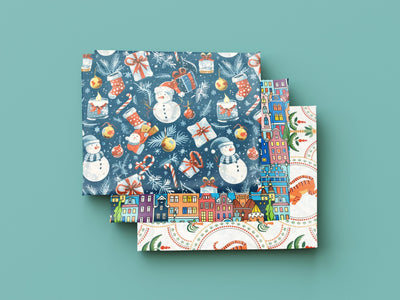
To make a fabric Christmas cracker, you sew a rectangle of cotton into a tube, slide a cardboard tube with the gift inside into the middle, and tie each end with ribbon. For a standard cracker around a toilet roll tube, cut the fabric 32cm x 18cm. One metre of 112cm wide cotton makes 18 crackers, and each one takes about 15 minutes to sew. Fabric crackers are not pulled with a bang. You untie them, and you can refill and use them again every year. This guide covers sizes, how much fabric you need, an unlined and a lined method, a no-sew version and what to put inside.
They are a good make for the last weeks before Christmas, because the seams are short and straight and a whole set can be sewn in an evening. Our Christmas fabrics are 112cm (45in) wide printed cotton at £3.50 a metre, which is the width all the amounts below are based on.
What you need
- Fabric: light to medium-weight woven cotton or polycotton. Printed Christmas cotton, plain red or green cotton and fat quarters all work.
- Cardboard tubes: toilet roll tubes for standard crackers, kitchen roll tubes cut to length, or tubes rolled from thin card.
- Ribbon or cord: about 80cm per cracker, in two 40cm lengths.
- Fillings: a small gift, a joke and a paper hat (see below).
- Basics: thread, pins or clips, fabric scissors or a rotary cutter, a ruler and an iron.
Narrow ribbon is the easiest to tie neatly; a 30m pack of 6mm ribbon in ten colours ties more than 35 crackers. For bigger bows, 48mm wide ribbon looks more generous, and gold cord or ric rac gives a more traditional look.
If you do not have enough tubes saved, roll your own. Cut a piece of thin card 15cm x 10cm, roll it round a broom handle or a rolling pin to about 4.5cm across, and tape the seam. A pack of A4 card sheets makes two tubes per sheet.
Cracker sizes and how much fabric you need
A standard cracker is about 28cm long, with a 10cm tube in the middle and 9cm of gathered fabric at each end. The cutting sizes below include a 1cm seam allowance along the long edge and a 2cm double hem at each end.
| Cracker | Tube | Cut fabric | Finished length | From 1m of 112cm fabric | From one fat quarter |
|---|---|---|---|---|---|
| Mini (tree decoration) | 5cm (half a toilet roll) | 22cm x 18cm | About 18cm | 25 | 6 |
| Standard (table) | 10cm (toilet roll) | 32cm x 18cm | About 28cm | 18 | 3 |
| Large (bigger gifts) | 15cm (cut kitchen roll) | 40cm x 18cm | About 36cm | 14 | 3 |
The 18cm width wraps a standard 4.5cm cardboard tube with a little ease, so the tube slides in and out easily. For a lined cracker, double the fabric: cut one outer and one lining piece for each cracker.
For a table set, 0.5m of 112cm fabric makes 9 standard crackers: one 32cm strip across the width gives six pieces, and the 18cm left over gives three more. If you want every cracker in a different print, a fat quarter bundle is simpler. The 6-piece Christmas fat quarter bundle makes 18 standard crackers, three in each print. A fat quarter is about 50cm x 55cm; cut the pieces with the 32cm side along the 50cm edge.
How to make a fabric Christmas cracker (unlined)
This is the quickest method, and the one to use for a big set. The fabric is a single layer, so choose a print that looks good on the right side only and does not show through too much.
1. Cut the fabric
Cut a rectangle 32cm x 18cm for each cracker. If the print has a direction, such as standing Santas or trees, make sure it runs across the 18cm width so it is the right way up when the cracker lies on the table. Washing the fabric first is optional for crackers, but it stops them shrinking if you wash them later; how to wash fabric properly explains how for each fibre.
2. Hem the short ends
On each 18cm end, fold 1cm to the wrong side and press, then fold another 1cm and press again. Stitch close to the inner fold, using thread to match the fabric; our haberdashery has assorted reels. These ends will be gathered with ribbon and show on the table, so a neat hem makes a big difference. For a quicker finish, trim the ends with pinking shears or a zigzag stitch instead of hemming.
3. Sew the tube
Fold the rectangle in half lengthways, right sides together, so the long edges meet. Sew along the long edge with a 1cm seam. Zigzag or overlock the raw edges if the fabric frays. Turn the tube right side out and press it flat, with the seam running along one side or the centre back.
4. Fill the cardboard tube
Put the gift, the joke and the folded hat inside the cardboard tube. If the gift is loose and small, wrap it in tissue first so it does not rattle out of the ends.
5. Put the tube inside the fabric
Slide the filled tube into the middle of the fabric tube, with the fabric seam underneath. There should be about 9cm of fabric at each end.
6. Tie the ends
Gather one end tightly, right against the end of the cardboard tube, and tie it with a 40cm length of ribbon in a bow. Repeat at the other end. Fluff out the fabric beyond the ribbon so the ends flare. That is the finished cracker.
Clips hold the slippery fabric better than pins when you sew the long seam; if you are not sure which to use, the guide to sewing pins and their uses covers the options.
A lined fabric cracker
A lining gives a cracker more body, a clean inside and a contrast flash of colour at the ends. It takes about 10 minutes longer per cracker but needs no hemming.
- Cut one outer and one lining piece, each 32cm x 18cm. Plain red, green, gold or white cotton makes a good lining for a busy print.
- Place them right sides together and sew across both 18cm ends with a 1cm seam.
- Turn right side out so the seams are inside, and press the two ends flat. You now have a two-layer rectangle with clean ends.
- Press it flat with the outer fabric on the outside. Fold it in half lengthways so the outer is on the inside, and sew the long edge through all four layers with a 1cm seam.
- Zigzag the raw edges, turn right side out and press.
- Fill the cardboard tube, slide it in and tie the ends as above.
For a cracker that holds its shape like a bought one, iron a light interfacing to the outer piece before sewing. Our guide to wadding, interfacing and stuffing explains which weight to choose.
No-sew fabric crackers
If you have no time or no sewing machine, you can still make fabric crackers. Cut the fabric 32cm x 22cm, with pinked or straight edges. Lay the filled cardboard tube across one long edge and roll it up, with the raw edge underneath. Hold it closed with a small dab of fabric glue or double-sided tape along the overlap, then tie each end with ribbon. These look very like the sewn version from the top and take about five minutes each. They are a good job to give children at the weekend before Christmas, and if you make your own fat quarter bundle, everyone can choose their own print.
The same idea works as reusable fabric gift wrap for other small presents. Wrap, tie and pass it on.
What to put inside a fabric cracker
A standard toilet roll tube holds anything about 4cm across and up to 10cm long. Traditional fillings are a paper hat, a joke and a small gift, but because you choose them yourself, you can make them much better than the plastic novelties in bought crackers.
- Paper hats: cut a strip of tissue paper 60cm x 12cm, zigzag the top edge into points, tape it into a ring and fold it small. Or sew a reusable fabric crown from scraps.
- Jokes: write or print them on small strips of card. Personal jokes and family quizzes go down better than shop-bought ones.
- Gifts for adults: miniature drinks, good chocolate, lip balm, a nail file, a keyring, seed packets, a small candle or a scratchcard.
- Gifts for children: hair clips, a mini puzzle, stickers, a bouncy ball, chocolate coins or a small toy.
- Handmade gifts: a scrunchie, a key fob or a lavender bag from your scraps; what to sew with fabric scraps has cutting sizes for each.
Cracker snaps, the strips that make the bang, can be bought from craft shops and taped inside the cardboard tube. Because fabric crackers are tied rather than glued, though, they will not tear apart when pulled, so most people leave the snap out.
How much do fabric crackers cost?
Fabric crackers cost much less to make than good quality bought crackers, and you keep them for years.
| Set | Fabric | Ribbon | Approximate cost |
|---|---|---|---|
| 8 standard crackers, unlined | 0.5m Christmas cotton (£1.75) | 6.4m from a 30m pack | About £2.40, or 30p each |
| 8 standard crackers, lined | 0.5m print + 0.5m plain (£3.50) | 6.4m | About £4.15, or 52p each |
| 18 crackers, each a different print | 6-piece Christmas fat quarter bundle (£9.25) | 14.4m | About £10.70, or 60p each |
The ribbon is costed at £3 for a 30m pack. Fillings are on top, but you would buy those anyway. A 0.5m cut gives nine pieces, so you have a spare for mistakes or a ninth guest. For plainer and cheaper fabric for linings and practice runs, our printed fabrics and plain polycotton are worth a look.
Why make reusable crackers?
Most paper crackers, with their plastic toys and foil, go straight in the bin on Christmas Day. Many are not recyclable because of the glitter and the foil finishes. A set of fabric crackers comes out of the decorations box every year, can be refilled to suit who is coming, and can be washed if it gets wine on it. For more ideas on making your sewing more sustainable, see smart fabric choices.
Matching table sets and gifts
Fabric crackers look best as part of a set. Sew them in the same prints as your napkins, table runner or bunting, so the whole table matches. Mini crackers in coordinated prints also make good tree decorations alongside mini stockings; our Christmas stocking guide has the mini size. And a set of six filled crackers tied in a bundle with ribbon is a thoughtful present for the host. For a gift bag to put them in, see how to make a drawstring bag.
If you are planning several festive makes, the Christmas sewing plan sets out what to make when, so table linen and crackers fall in the last weeks before the big day. Crackers also sell well at December craft fairs in sets of four or six; the UK guide to sewing to sell at craft fairs covers pricing.
Fabric Christmas cracker FAQs
How much fabric do I need for a fabric Christmas cracker?
For a standard cracker made around a toilet roll tube, cut one piece of fabric 32cm x 18cm. One metre of 112cm wide cotton makes 18 crackers, 0.5m makes 9 and a fat quarter makes 3. A lined cracker needs twice as much. For other projects from a single cut, see what you can make with 1 metre of fabric.
What is the best fabric for Christmas crackers?
Light to medium-weight woven cotton is best, because it gathers neatly at the ends and presses crisply. Christmas printed cotton, quilting cotton and polycotton all work. Avoid thick fabrics such as velvet or fleece, which are too bulky to tie tightly.
Can fabric Christmas crackers go bang?
Not really. You can tape a cracker snap inside the cardboard tube, but fabric crackers are tied with ribbon rather than glued, so they do not tear apart when pulled. Most people untie them instead and keep the fun for the jokes and gifts.
How long does it take to make fabric crackers?
About 15 minutes each for unlined crackers, or 25 minutes lined, once you have cut them out. Sewing a set in a batch is quicker: cut them all, hem all the ends, then sew all the tubes. A set of eight takes an evening.
Can you wash fabric Christmas crackers?
Yes. Take out the cardboard tube, then wash the fabric at 30 degrees and press it. Prewashing the fabric before you sew stops the crackers shrinking the first time they are washed. Keep the tubes and ribbon with them in the decorations box for next year.